Dr. Lindsay Thorn, DMD, MS, FAGD | LAT Dentistry | Roanoke, Virginia
If you're struggling with missing teeth, failing dental work, or uncomfortable dentures, you've probably seen advertisements promising a brand-new smile in just one day.
Treatments like "All-on-4," "All-on-X," and "teeth in a day" have transformed what's possible in dentistry. For many people, these procedures provide an incredible opportunity to regain their confidence and ability to eat comfortably.
But there's something important that doesn't always make it into the advertisements:
Just because we can replace all your teeth in one day doesn't necessarily mean we should.
At LAT Dentistry in Roanoke, Virginia, we believe that exceptional dentistry begins with understanding the whole person—not simply selecting a procedure.
When considering extensive dental treatment, the goal shouldn't just be getting new teeth as quickly as possible. It should be creating a healthy, functional, beautiful, and maintainable smile that serves you for decades to come.
Tooth Loss Is More Than a Cosmetic Concern
According to the Centers for Disease Control and Prevention (CDC), approximately 15% of adults aged 65 and older have lost all their natural teeth, and 26% have eight or fewer teeth remaining.
Tooth loss can affect much more than appearance. Missing teeth can make it difficult to chew nutritious foods, speak comfortably, and smile confidently. Over time, tooth loss can also contribute to changes in jawbone structure and facial appearance.
Fortunately, modern dentistry offers more ways than ever to restore missing teeth and improve quality of life.
The key is choosing the right solution for your individual needs.
What Are All-on-4, All-on-X, and "Teeth in a Day"?
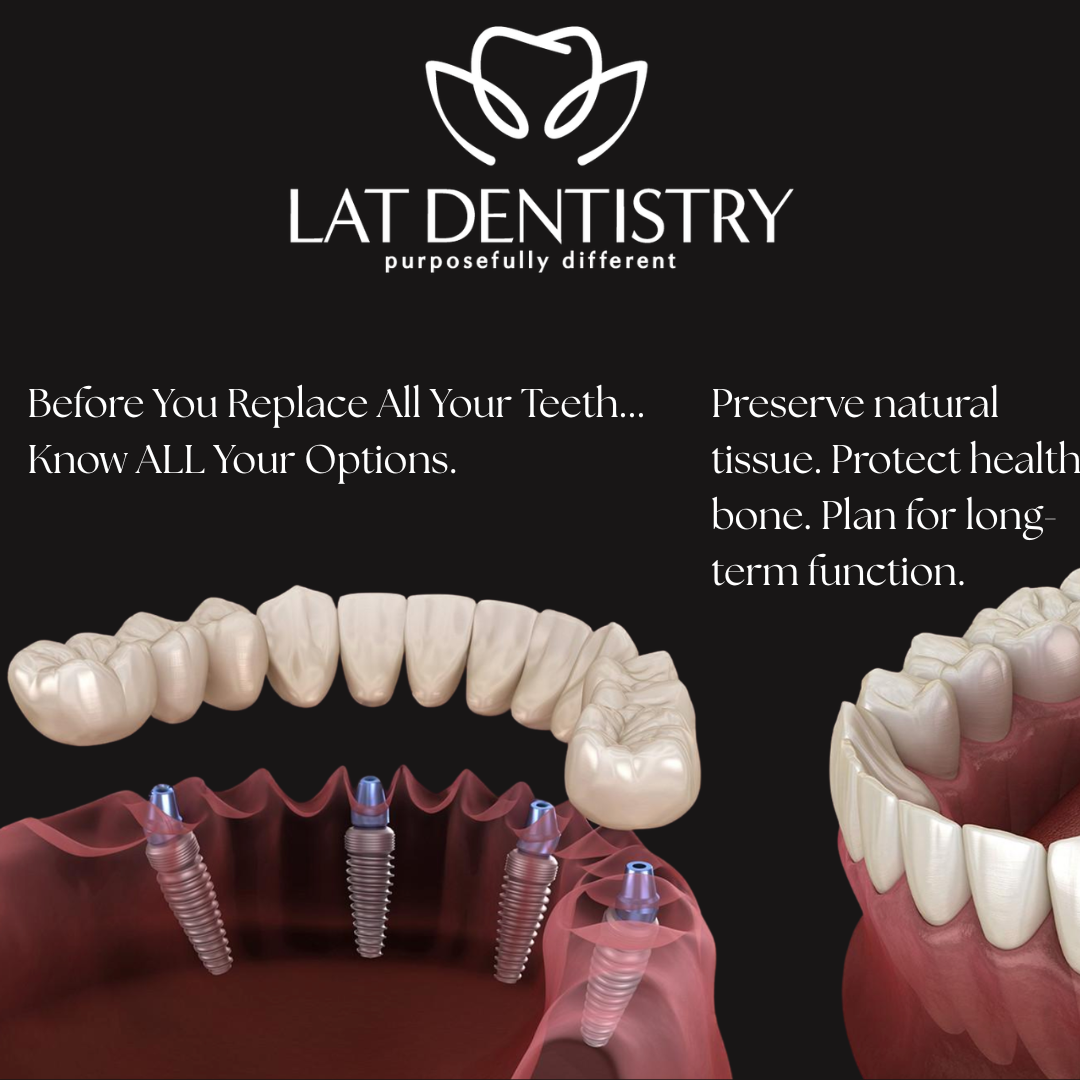
All-on-4 and All-on-X are approaches to replacing an entire upper or lower arch of teeth using dental implants.
Rather than placing an individual implant for every missing tooth, a dentist or surgical specialist places a smaller number of implants—often four to six—to support a complete set of replacement teeth.
In appropriately selected cases, a temporary fixed restoration can be attached on the same day as implant surgery. This is where the term "teeth in a day" comes from.
These treatments can be life-changing for patients who have lost all their teeth or whose remaining teeth cannot predictably be saved.
However, receiving teeth on the same day does not mean the treatment is complete. Implants still need time to integrate with the jawbone, and patients typically require healing, follow-up appointments, and a definitive restoration.
All-on-X in a day can be an excellent treatment option. But it's one option—not the only option.
Why Saving Your Natural Teeth Should Be Part of the Conversation
Dental implants are one of the most remarkable advancements in restorative dentistry. But even the best dental implant isn't automatically better than a healthy, functioning natural tooth.
Your natural teeth are connected to the surrounding bone through the periodontal ligament, which helps provide sensory feedback during chewing.
When a tooth is removed, that natural structure is lost. And while implants can provide excellent support for replacement teeth, they don't fully replicate every feature of a natural tooth.
For someone with multiple dental problems, removing everything and starting over may seem like the simplest solution.
Sometimes, it truly is the most predictable and appropriate approach.
But in other cases, a carefully planned combination of treatments—such as crowns, bridges, periodontal therapy, and individual dental implants—may allow us to preserve healthy teeth and maintain more of the patient's natural anatomy.
Once a tooth is extracted, we cannot put that natural tooth back.
That is why a comprehensive assessment of which teeth can be predictably maintained should always be part of the discussion before committing to full-mouth extractions.
An Important Question: Will Healthy Jawbone Need to Be Removed?
One of the least discussed aspects of certain full-arch dental implant procedures is the potential need to remove A LOT of jawbone.
Some full-arch implant restorations use replacement teeth attached to a prosthesis that also replaces a portion OR ALL of the patient's gum tissue. Dentists sometimes refer to this as an FP3 restoration.
Depending on the patient's anatomy, bone reduction—called alveoloplasty—may be performed to create space for the restoration, This involves drilling away most of the bone and gums in the mouth, and the final restoration will have fake pink gums added to it.
In certain situations, this is absolutely appropriate.
However, reducing healthy bone is irreversible. Removing more bone than necessary may affect future restorative options and the patient's remaining anatomical support.
Other approaches may allow the replacement teeth to emerge more naturally from the patient's existing gum tissue, preserving more of the surrounding anatomy.
A 2026 international expert consensus on full-arch implant rehabilitation recommended considering tooth-only or minimally tissue-replacing restorations, often called FP1 or FP2, when anatomical conditions allow, to avoid extensive bone reduction. The authors also acknowledged that direct comparative research between these prosthetic designs remains limited.
The takeaway?
Your treatment should be designed around your anatomy—not your anatomy unnecessarily altered to accommodate a predetermined treatment design.
Preserving bone whenever clinically appropriate is an important consideration in comprehensive implant planning.
What Are the Alternatives to Full-Arch Implant Dentures?
If you're missing several teeth or facing extensive dental problems, you may have more options than you realize.
Depending on your oral health, treatment possibilities may include:
Preserving and restoring natural teeth: Periodontal treatment, crowns, onlays, or bridges may help maintain teeth with a favorable long-term prognosis.
Individual dental implants: Missing teeth can sometimes be replaced without removing adjacent healthy teeth.
Implant-supported bridges: Multiple missing teeth may be replaced using fewer implants than the number of teeth being restored.
Implant-retained removable dentures: Dental implants can improve denture stability while allowing the denture to be removed for cleaning.
Fixed full-arch implant restorations: All-on-4, All-on-X, and other full-arch approaches can provide a secure, non-removable-by-the-patient solution for extensive tooth loss.
There isn't one solution that's best for everyone.
The ideal choice depends on your dental health, bone anatomy, bite, appearance, ability to maintain the restoration, medical history, goals, and budget.
Why Advanced Training and Comprehensive Planning Matter
Replacing multiple teeth isn't simply about filling spaces in a smile.
It's about rebuilding a complex system that needs to function comfortably and predictably over time.
At LAT Dentistry, our comprehensive approach considers factors such as:
The health and prognosis of your remaining natural teeth
Jawbone quantity, quality, and anatomy
Gum and periodontal health
Your bite, chewing function, and jaw joints
Facial proportions, smile aesthetics, and lip support
Medical history and medications
Long-term maintenance, repairability, and future treatment needs
Extensive restorative treatment may also require collaboration with surgical and other dental specialists.
Two dentists may recommend different treatment plans for the same patient because there can be several clinically appropriate approaches.
That's why education and transparency are so important.
Before committing to extensive tooth removal or full-mouth reconstruction, patients deserve to understand not only the proposed treatment but also the reasonable alternatives and their respective advantages, limitations, costs, and long-term maintenance requirements.
Am I Too Old for Dental Implants or Full-Mouth Reconstruction?
One of the most common misconceptions among older adults is that they're simply too old to invest in their teeth.
Age alone does not determine whether someone is a candidate for dental implants or comprehensive restorative treatment.
A patient's overall health, medications, bone condition, healing capacity, and ability to maintain their dental work are often more important considerations than their chronological age.
Whether you're in your 60s, 70s, or 80s, improving your ability to eat, speak, and smile comfortably may have a meaningful impact on your quality of life.
And because major dental treatment can become more physically challenging with advancing age or declining health, it may be beneficial to explore your options before problems become more extensive.
Five Questions to Ask Before Choosing Full-Mouth Dental Implants
If you're considering All-on-4, All-on-X, or another extensive dental procedure, ask your dentist:
Can any of my existing teeth be predictably saved? Understand the prognosis of your remaining teeth and whether more conservative options are appropriate.
Will healthy jawbone need to be removed? Ask why bone reduction is necessary, how much is planned, and whether a bone-preserving alternative is possible.
What other treatment options should I consider? Request an explanation of fixed, removable, implant-supported, and tooth-preserving alternatives where appropriate.
How will my bite, appearance, and long-term function be evaluated and what will the final result look and feel like? A beautiful smile must also be comfortable, functional, and maintainable.
What happens 10 or 20 years from now? Ask about maintenance, repair costs, potential complications, and what options may remain if a restoration or implant fails.
A qualified dentist should welcome these questions and help you make an informed decision without feeling rushed.
Comprehensive, Personalized Dental Care in Roanoke, VA
At LAT Dentistry, our philosophy is simple: We don't believe in one-size-fits-all dentistry.
Dr. Lindsay Thorn, DMD, MS, FAGD, and Dr. Andrea Marquez, DDS, are committed to continuing education, comprehensive care, and thoughtful treatment planning.
Whether you're missing one tooth, struggling with dentures, facing extensive restorative needs, or considering a full-mouth reconstruction, our goal is to help you understand your options and make decisions that support your long-term oral health.
We believe patients deserve a judgment-free environment where they can ask questions, discuss concerns, and explore treatment options without pressure.
The best dentistry isn't necessarily the fastest or most aggressive treatment.
It's the right treatment for you—designed with your long-term health, function, and quality of life in mind.
Considering Dental Implants or Full-Mouth Reconstruction in Roanoke?
Before making irreversible decisions about your teeth, start with a comprehensive dental evaluation.
Contact LAT Dentistry in Roanoke, VA, to schedule a consultation and discuss your dental health, treatment goals, and potential options.
LAT Dentistry
1113 Piedmont Street
Roanoke, VA 24014
(540) 904-4020
www.latdentistry.com
Your smile deserves a plan—not just a procedure.