The Mouth-Body Connection
7 Warning Signs Your Mouth May Be Telling You Something About Your Overall Health
When most people think about visiting the dentist, they think about cavities, clean teeth, or getting a brighter smile. But your mouth is much more than just teeth—it often provides some of the earliest clues about your overall health.
As dentists, we have a unique opportunity to identify changes in the mouth that may indicate underlying medical conditions, nutritional deficiencies, sleep disorders, or chronic inflammation long before they become more serious. In many cases, your routine dental exam may uncover health concerns you didn’t even know you had.
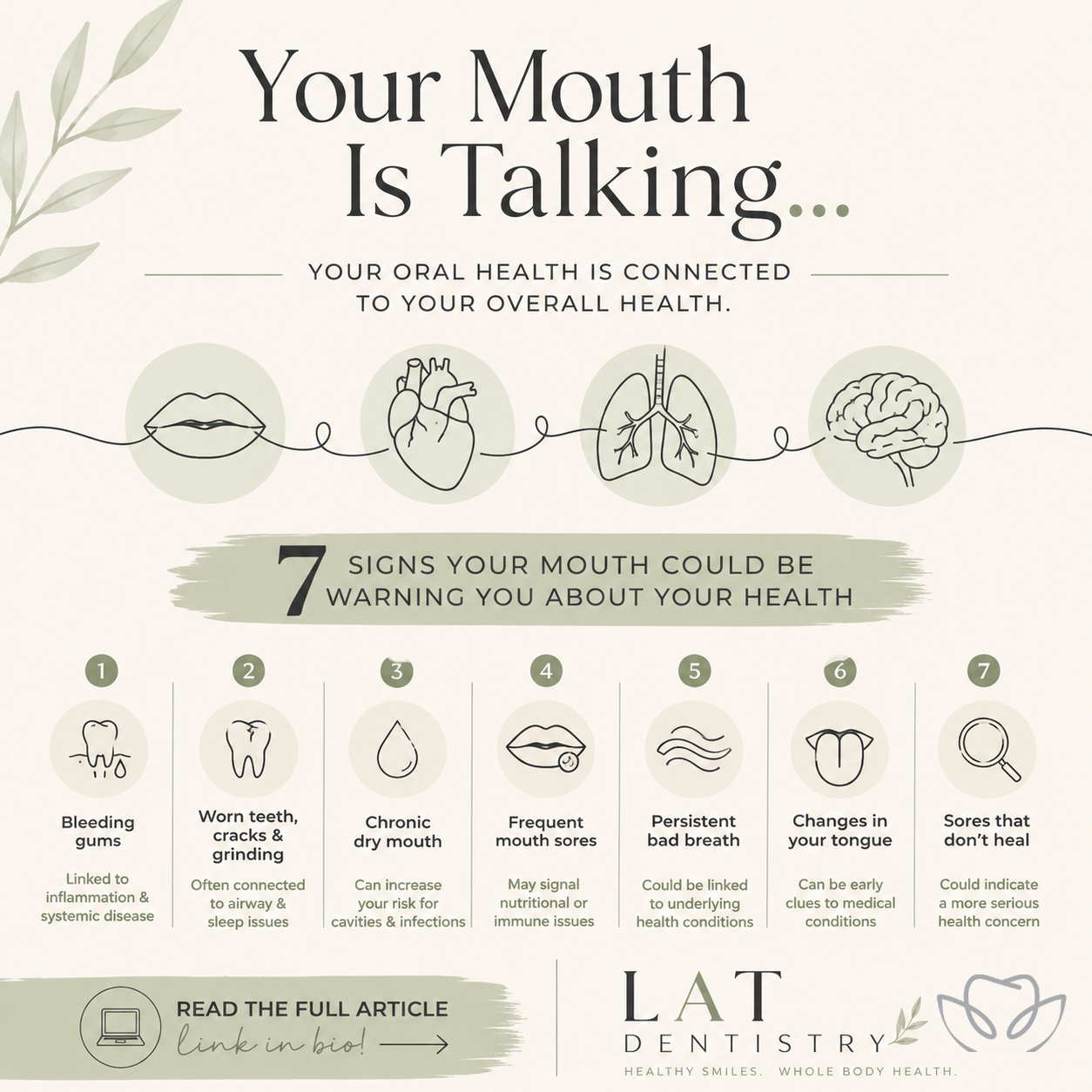
Here are seven warning signs your mouth may be trying to tell you something about the rest of your body.
1. Bleeding Gums Could Mean More Than Gingivitis
Many people assume bleeding gums are normal—especially while brushing or flossing. They’re not.
Healthy gums should not bleed. Bleeding is one of the earliest signs of periodontal (gum) disease, a chronic bacterial infection that causes inflammation in the tissues supporting your teeth.
While gum disease starts in the mouth, the inflammation doesn’t necessarily stay there.
Researchers have found strong associations between periodontal disease and numerous systemic conditions, including:
· Heart disease
· Stroke
· Diabetes
· Alzheimer’s disease
· Rheumatoid arthritis
· Pregnancy complications
· Chronic kidney disease
· Respiratory disease
Scientists believe one reason for this connection is chronic inflammation. Inflamed gums allow bacteria and inflammatory molecules to enter the bloodstream, where they may contribute to inflammation throughout the body.
It’s important to remember that gum disease does not necessarily cause these diseases, but chronic inflammation is increasingly recognized as an important contributor to many health conditions. In fact, patients with diabetes and periodontal disease often experience a two-way relationship—poorly controlled diabetes can worsen gum disease, while treating periodontal disease may improve blood sugar control.
The good news? Gum disease is often preventable and highly treatable when caught early.
If your gums bleed, don’t ignore it. It may be your body’s way of asking for help.
2. Worn Teeth, Cracks, or Grinding May Point to an Airway Problem
Many people assume they grind their teeth simply because they’re stressed.
While stress certainly plays a role, we now understand that nighttime grinding (bruxism) is frequently associated with airway problems during sleep.
When the airway begins to collapse—even briefly—the brain may activate the jaw muscles in an attempt to reposition the lower jaw and reopen the airway. This repeated muscle activity can lead to:
· Flattened or worn teeth
· Cracked teeth
· Broken fillings or crowns
· Jaw soreness
· Headaches
· Tooth sensitivity
In many patients, teeth grinding isn’t the primary problem—it’s a symptom.
Other signs that may point toward an airway issue include:
· Loud snoring
· Daytime fatigue
· Morning headaches
· Dry mouth upon waking
· Difficulty concentrating
· Frequent nighttime awakenings
This doesn’t mean everyone who grinds their teeth has obstructive sleep apnea, but persistent tooth wear or repeated fractures should prompt a conversation about sleep quality and airway health.
At LAT Dentistry, we evaluate not only what’s happening to your teeth, but also why it’s happening. Addressing the underlying cause often leads to better long-term outcomes than simply replacing broken teeth over and over again.
3. Chronic Dry Mouth Can Greatly Increase Your Risk for Cavities
Saliva is one of your body’s greatest natural defenses.
It helps neutralize acids, wash away food particles, control harmful bacteria, and strengthen tooth enamel.
When saliva production decreases, the risk of dental disease rises dramatically.
Dry mouth can be caused by:
· More than 500 common medications
· Diabetes
· Autoimmune diseases such as Sjögren’s syndrome
· Cancer treatments
· CPAP use
· Mouth breathing
Patients with chronic dry mouth often develop cavities rapidly—even if they’ve never had dental problems before.
If your mouth frequently feels dry, it’s worth discussing with both your physician and dentist.
4. Frequent Mouth Ulcers May Signal Nutritional or Immune Problems
An occasional canker sore is common.
However, recurring mouth ulcers may sometimes indicate:
· Iron deficiency
· Vitamin B12 deficiency
· Folate deficiency
· Celiac disease
· Inflammatory bowel disease
· Immune disorders
· Significant stress
If ulcers become frequent, severe, or don’t heal within two weeks, they deserve evaluation.
5. Persistent Bad Breath May Be More Than a Hygiene Issue
Bad breath isn’t always caused by food or poor brushing.
Persistent halitosis can result from:
· Gum disease
· Dry mouth
· Tonsil stones
· Acid reflux
· Sinus infections
· Diabetes
· Certain gastrointestinal conditions
While mouthwash may temporarily mask the odor, identifying the underlying cause is the key to lasting improvement.
6. Changes in Your Tongue May Reveal Medical Conditions
Your tongue can provide valuable clues about your health.
For example:
· A smooth, shiny tongue may suggest vitamin deficiencies.
· A bright red tongue can sometimes be associated with nutritional deficiencies or certain infections.
· White patches may indicate fungal infections or require evaluation to rule out more serious conditions.
· Enlarged or scalloped tongues are sometimes seen in patients with airway disorders or sleep apnea.
Because the tongue changes quickly in response to illness, dentists often notice abnormalities during routine exams before patients are aware of them.
7. A Sore That Doesn’t Heal Could Be Oral Cancer
One of the most important reasons to maintain regular dental visits is oral cancer screening.
Oral cancer can affect anyone—not just smokers.
Risk factors include:
· Tobacco use
· Heavy alcohol use
· HPV infection
· Excessive sun exposure (for lip cancers)
· Increasing age
Early oral cancer often causes little or no pain, making professional screening especially important.
If you notice a sore, lump, red or white patch, or ulcer that hasn’t healed after two weeks, don’t wait. Have it evaluated promptly.
Your Mouth Is Part of Your Whole Body
Modern dentistry isn’t just about fixing teeth—it’s about improving overall health.
Every dental examination provides an opportunity to detect disease early, reduce chronic inflammation, preserve healthy teeth, and sometimes identify medical conditions before they become more serious.
At LAT Dentistry, we believe in comprehensive, preventive care that looks beyond individual teeth. We consider how your oral health, airway, nutrition, medical history, and lifestyle all work together to influence your long-term wellness.
Your mouth may be saying more than you realize. The question is: Is anyone listening?
Schedule Your Comprehensive Dental Evaluation
Whether you’re experiencing bleeding gums, tooth wear, dry mouth, jaw discomfort, or simply haven’t had a dental examination in a while, we’d love to help.
Our goal isn’t just to create healthy smiles—it’s to help you achieve better overall health.